

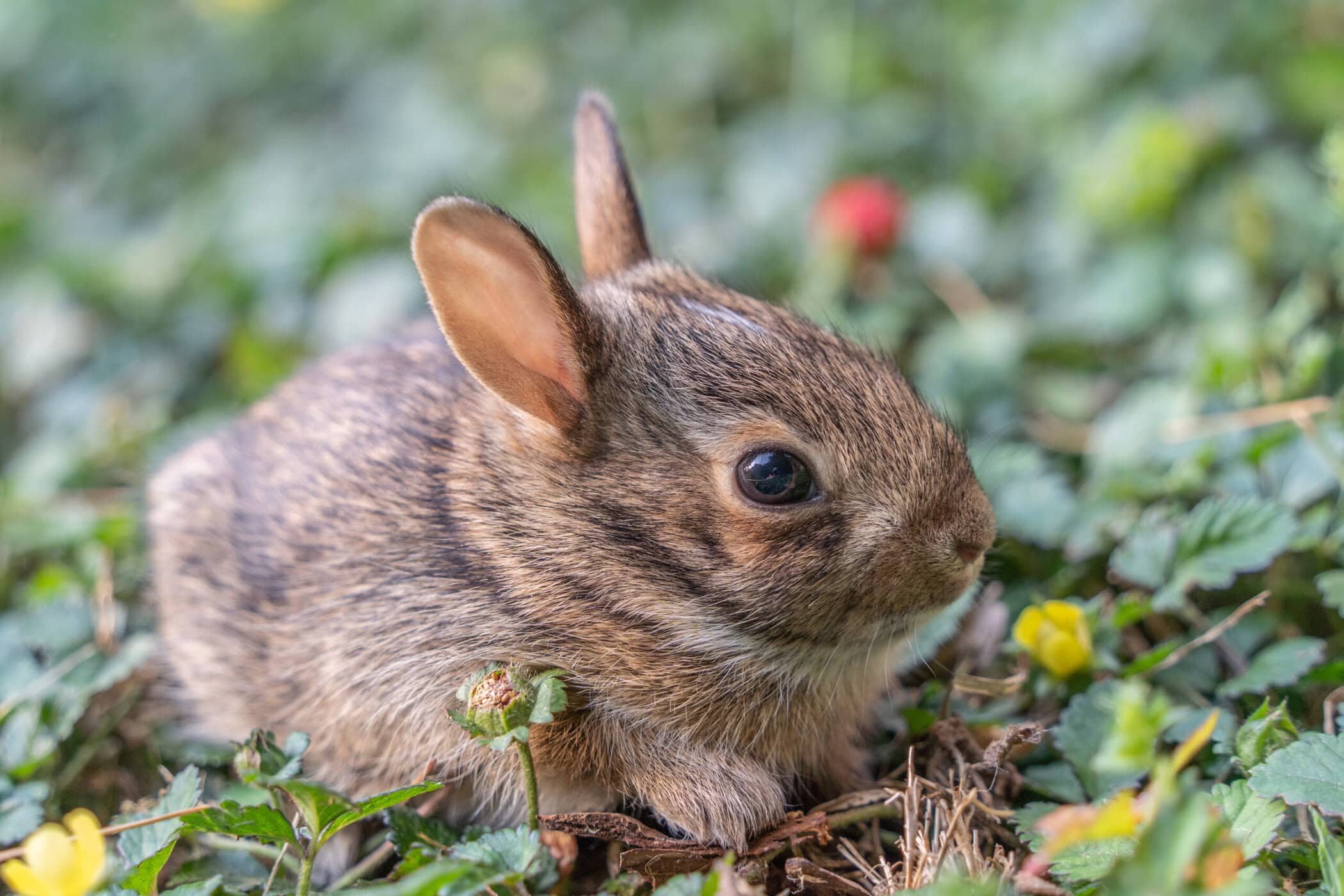
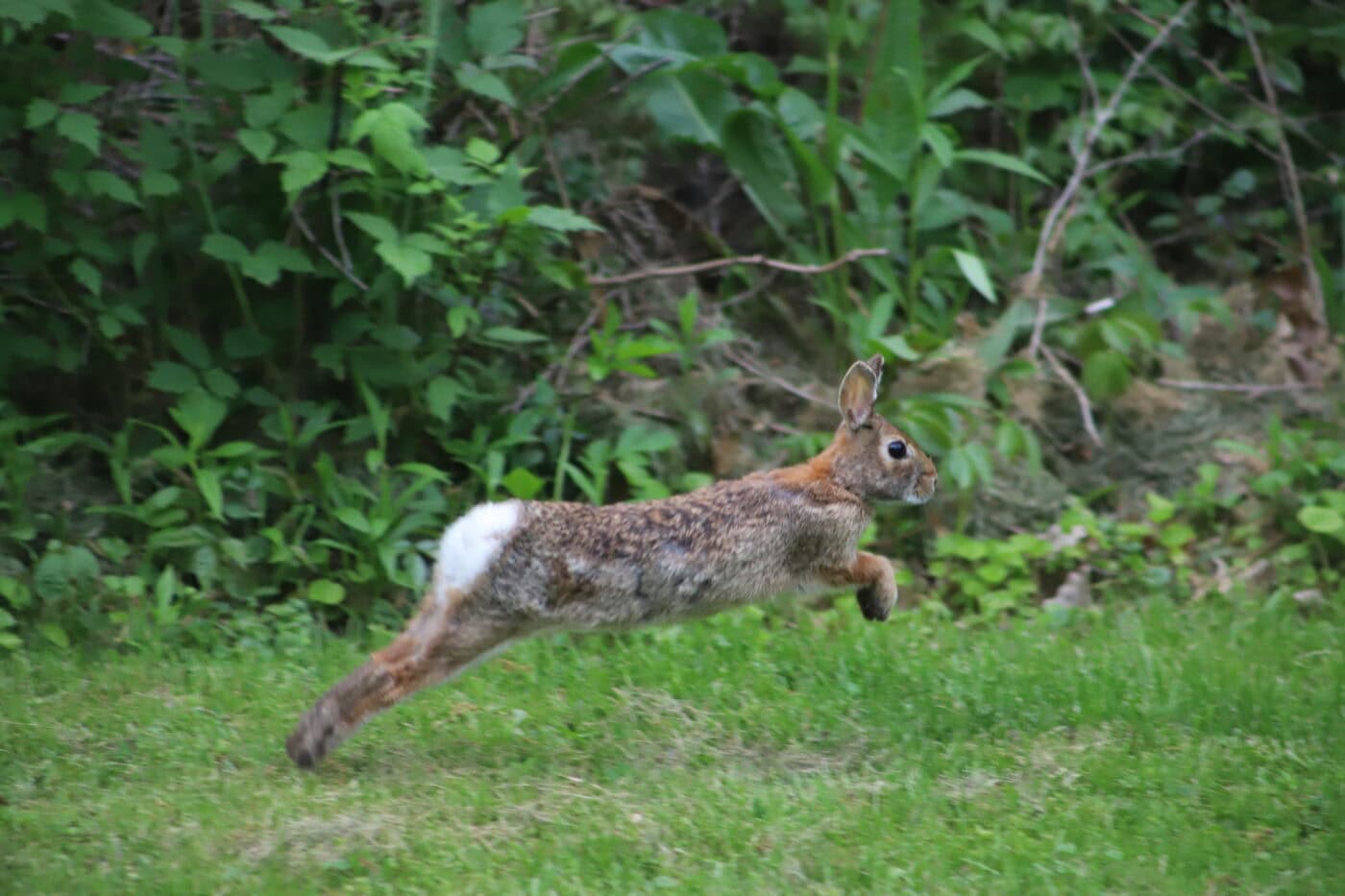
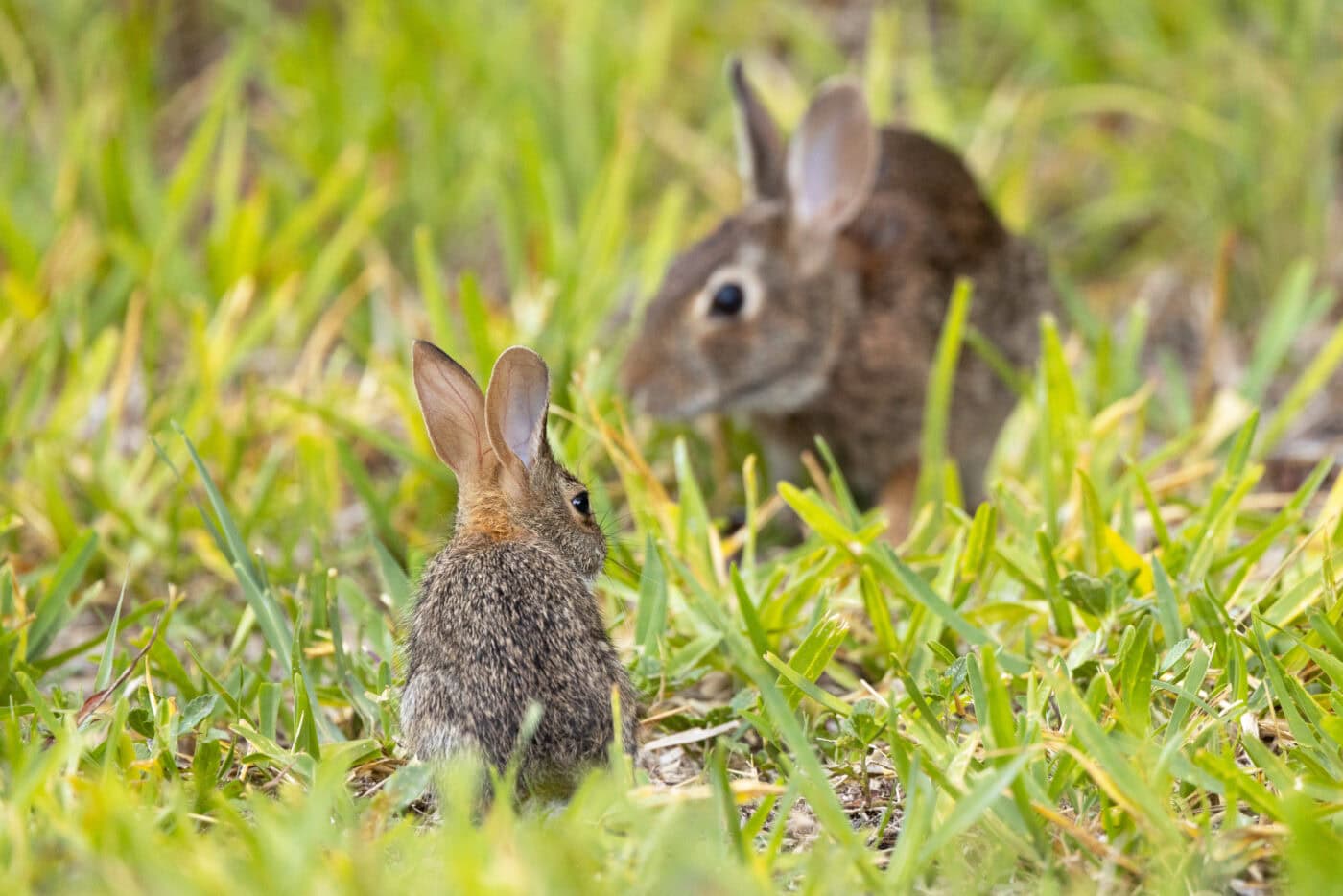
A bane to gardeners, but a boon to people who love cuteness: We’re talking about bunny rabbits. New York is home to two species of rabbits: the Eastern cottontail and the New England cottontail. The cottontail is named for its short brown and white tails; often, the only part of a rabbit that’s visible is the tail’s white undersurface as a bunny scampers away.
Cottontail rabbits are among New York’s most common mammals. Introduced to the Northeast in the early to mid-1900s, the Eastern cottontail thrives in the Empire State’s fields and farmland, and along the edges of forests.

The New England cottontail lives in dense thickets and is native to New York, but its numbers are declining due to a mix of habitat loss, habitat fragmentation, competition with Eastern cottontails, and declining shrubland habitat. In New York, the New England cottontail is considered a species of special concern, found east of the Hudson River and mainly in the Hudson Valley counties of Columbia, Dutchess, Putnam, and Westchester.
The snowshoe hare is sometimes listed as one of the Empire State’s rabbit species, and it can be found in the Adirondacks, but hares differ from rabbits in some key ways. For instance, while newborn rabbits are blind, hairless, and do not open their eyes for about a week, hares are born fully furred, capable of hopping, and with eyes wide open. Hares are also bigger than rabbits.

Rabbits have several trademark features that make them instantly recognizable: long ears, powerful hind legs, and short tails. There are 29 species of rabbits, and they vary in size, from the tiny pygmy rabbit at 7.9 inches to Guinness World Record Holder Darius, a continental giant (a domesticated breed) who measured 4 feet 3 inches and weighed 50 pounds. Rabbits are found on every continent but Antarctica.
Wild rabbits move swiftly when under threat. Their strong hind legs let them accelerate quickly, and the Eastern cottontail can run up to 18 miles per hour, often zigzagging to confuse faster predators like owls, eagles, hawks, foxes, and bobcats.
Bugs Bunny might subsist solely on a diet of carrots, but in the real world, wild rabbits prefer greens — grasses, clovers, weeds — and don’t eat root veggies unless in captivity. In fact, the Royal Society for the Prevention of Cruelty to Animals has warned that too many people are feeding their pet rabbits carrots and lettuce, putting them at risk for tooth decay and other health problems. When winter comes, cottontails consume more bark and twigs from species like sumac, white and black oak, dogwood, apple, willow, maple, and poison ivy.
Rabbits have one yucky dietary habit, at least from a human perspective: They eat their own poop, something called coprophagy. They engage in this peculiar practice because the food rabbits eat isn’t easy to digest, and by the time a meal has worked its way through their intestines, it still contains many nutrients. Rather than waste nutrient-rich feces, rabbits eat and digest them a second time. Rabbits make two types of poop: round, dry droppings and softer droppings known as cecotropes, which is what they eat. Rabbits also have a one-way digestive system, which means they can’t vomit.
Rabbits have large eyes on the side of their head, and their vision is nearly 360 degrees, enabling them to see what’s coming from every direction. Their big ears can rotate 270 degrees, which gives them an acute sense of hearing — they can pick up sounds two miles away.
The phrase “breeding like rabbits” is rooted in truth. Rabbits are known for their high reproduction rate. They begin breeding at a young age, usually between three and eight months old, and might produce a litter of up to seven baby rabbits, called kittens, four to five times a year. The kittens grow quickly, and are usually weaned within a month.
“One might expect that the fields and woodlands would be overrun with rabbits as a result of their reproductive capabilities,” the Cornell University Cooperative Extension notes. “If no mortality occurred, one pair of rabbits and their offspring could give rise to 5 million rabbits over a 5-year period. In a natural, diverse ecosystem, the cottontail population is kept in check by a host of mortality factors. On the average, only 20 to 25% of the young live one full year. This means that including adult mortality, about 85% of the population dies each year.”
In New York, the best time to see rabbits is at dawn and dusk, because that is when they tend to feed and are most active.
Eagle-eyed nature observers can look for other signs of these common, but sometimes elusive animals: tooth marks on tree trunks or lower ground that are the result of rabbit gnawing, rabbit droppings (rabbits deposit between 250 to 500 pellets a day), and the distinctive “hopper” tracks they leave on the ground or in the snow, distinctive in part because the longer hind legs land in front of the smaller front feet.