


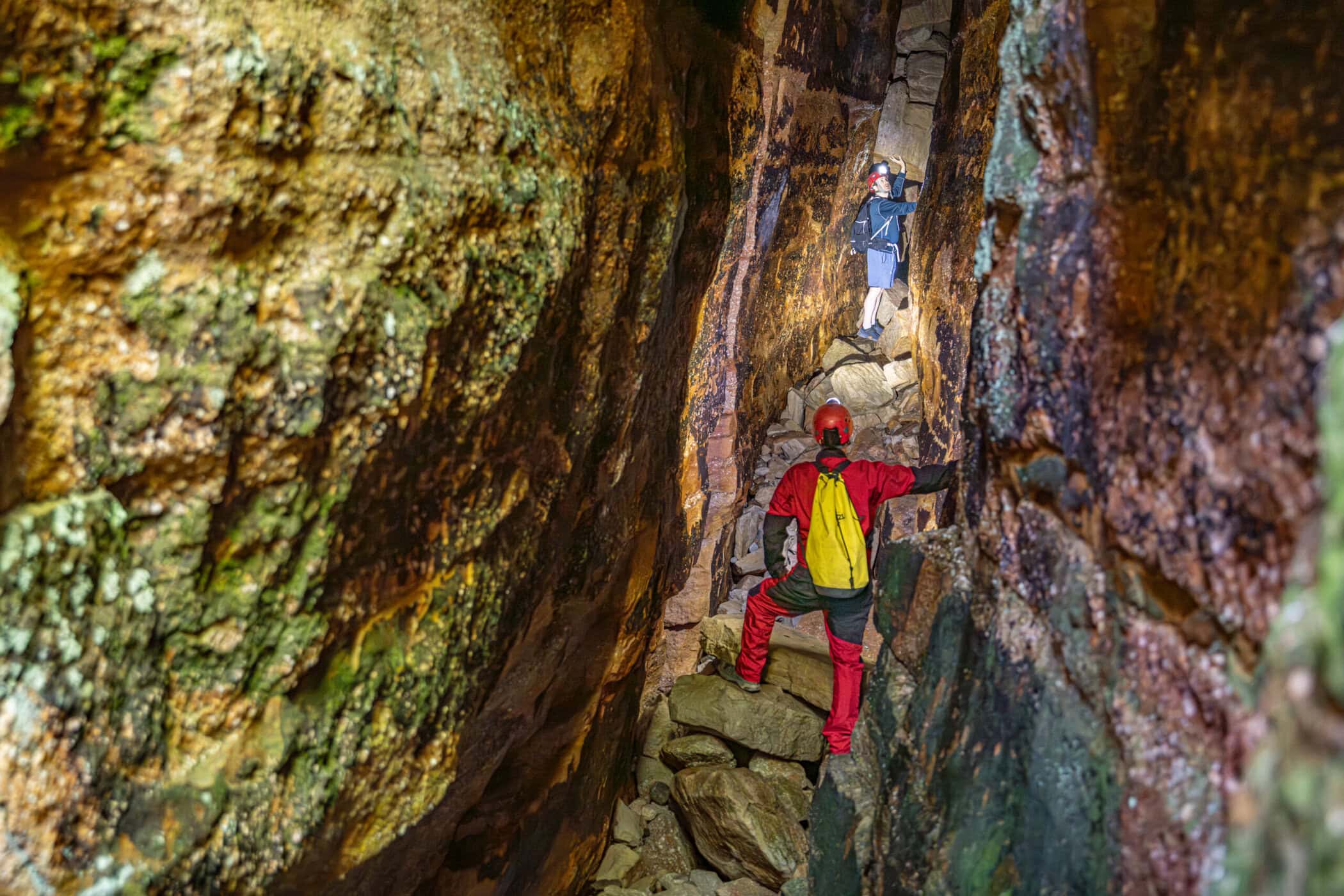
When most people think of caves, they might picture the limestone variety that have deep tunnels and cavernous openings where water drips from the stalactites. But this is not what you’ll find when visiting the ice caves of Minnewaska State Park.
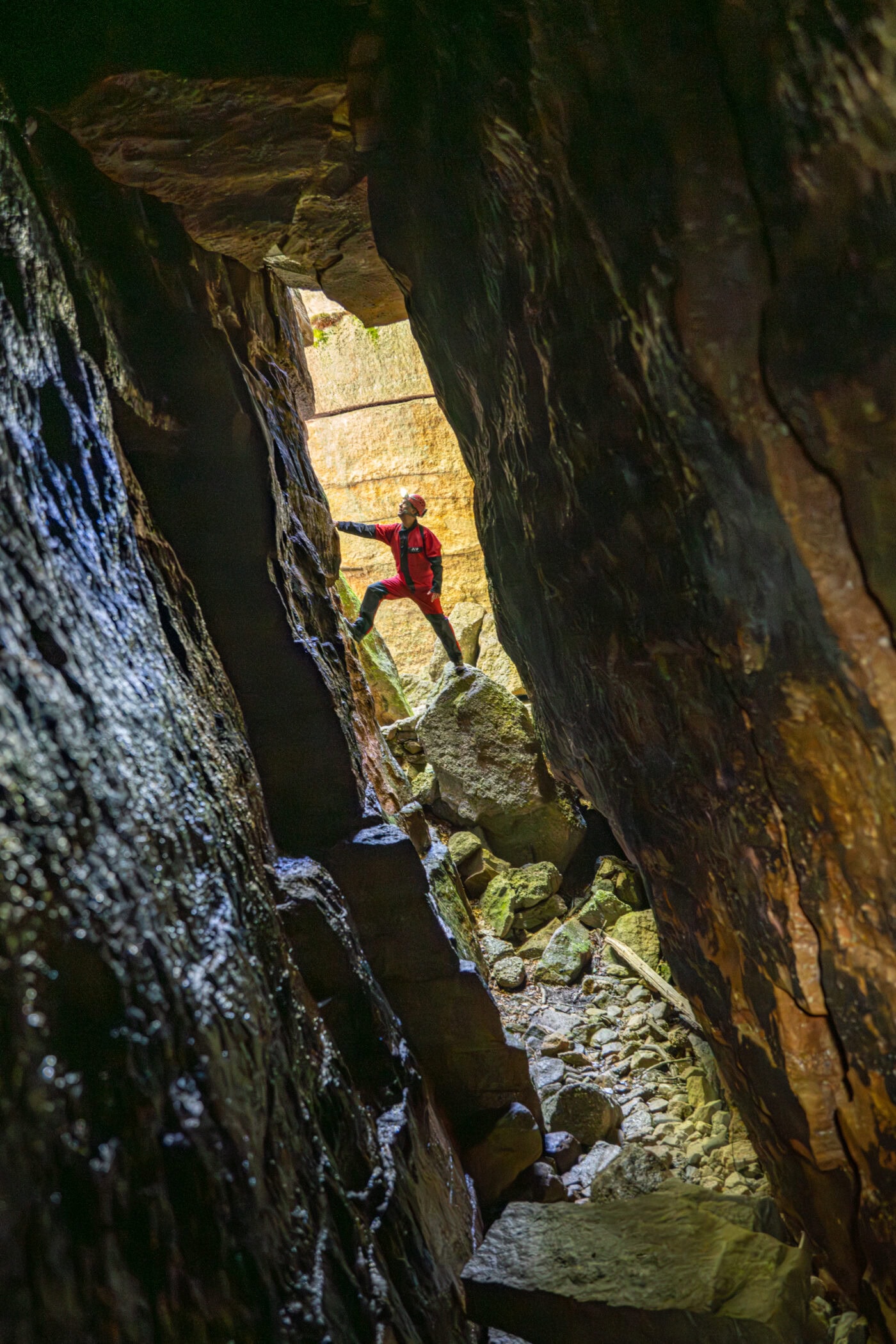
Instead, these ice caves are full of crevices and characterized by deep vertical splits in the rock, sometimes filled in with boulders possibly moved there by glaciers that once flowed through the Hudson Valley. And rather than being the product of erosion’s slow drip from within, Minnewaska’s ice caves have their origin in Pleistocene-era tectonic shifts in the bedrock below.
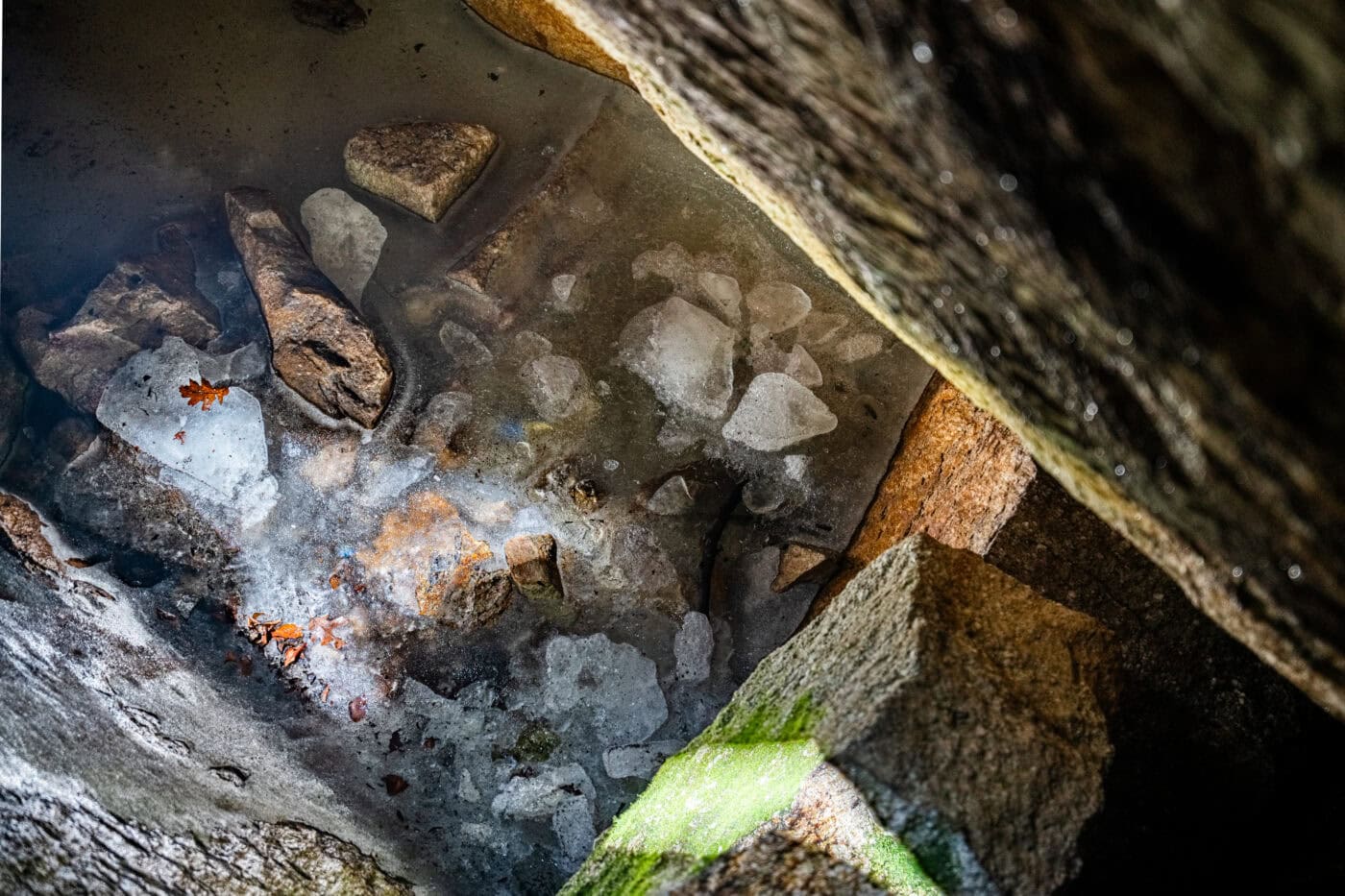
“The bedrock, the Shawangunk Formation, is primarily quartz conglomerate and sandstone, which has many vertical joints,” explains Rebecca Howe, an environmental educator stationed at the Sam’s Point Area, where Minnewaska’s most famous ice caves are found. “Water gets into these cracks, freezes, expands, and moves the rock.”
As if in homage to these ice age origins, Minnewaska’s ice caves get their name because they retain snow and ice well into the summer. Howe says this happens because the deep crevices trap colder air as it moves west to east across the Shawangunk Ridge. “The caves act as a refrigerator, keeping the temperatures around 55 degrees,” she says, “even in the dead of summer.”
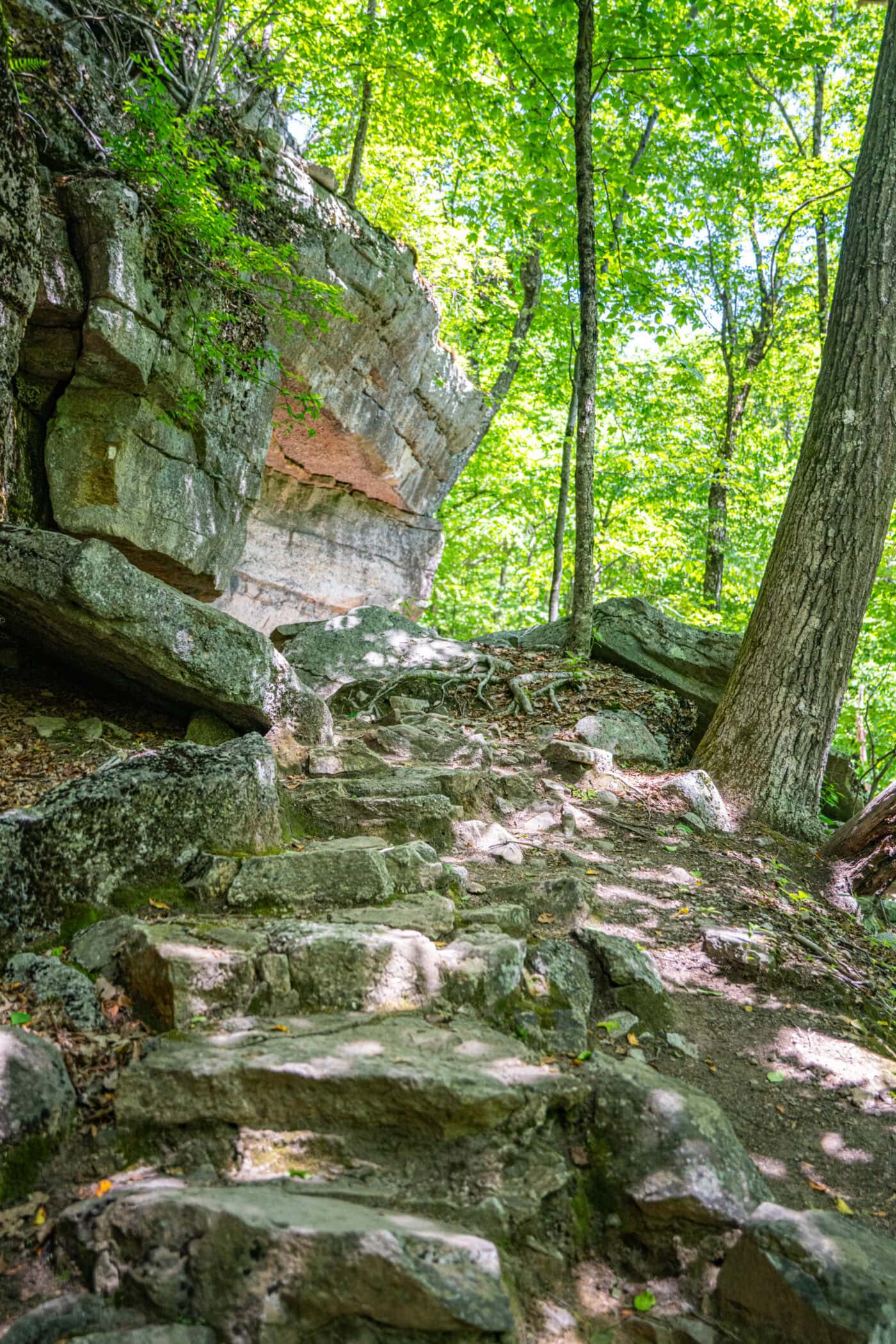
That temperature is ideal for summer hikers at Sam’s Point who want to cool off in the ice caves. It is also the perfect temperature for a small cave-dwelling crustacean that most people haven’t heard of: the Allegheny cave amphipod.
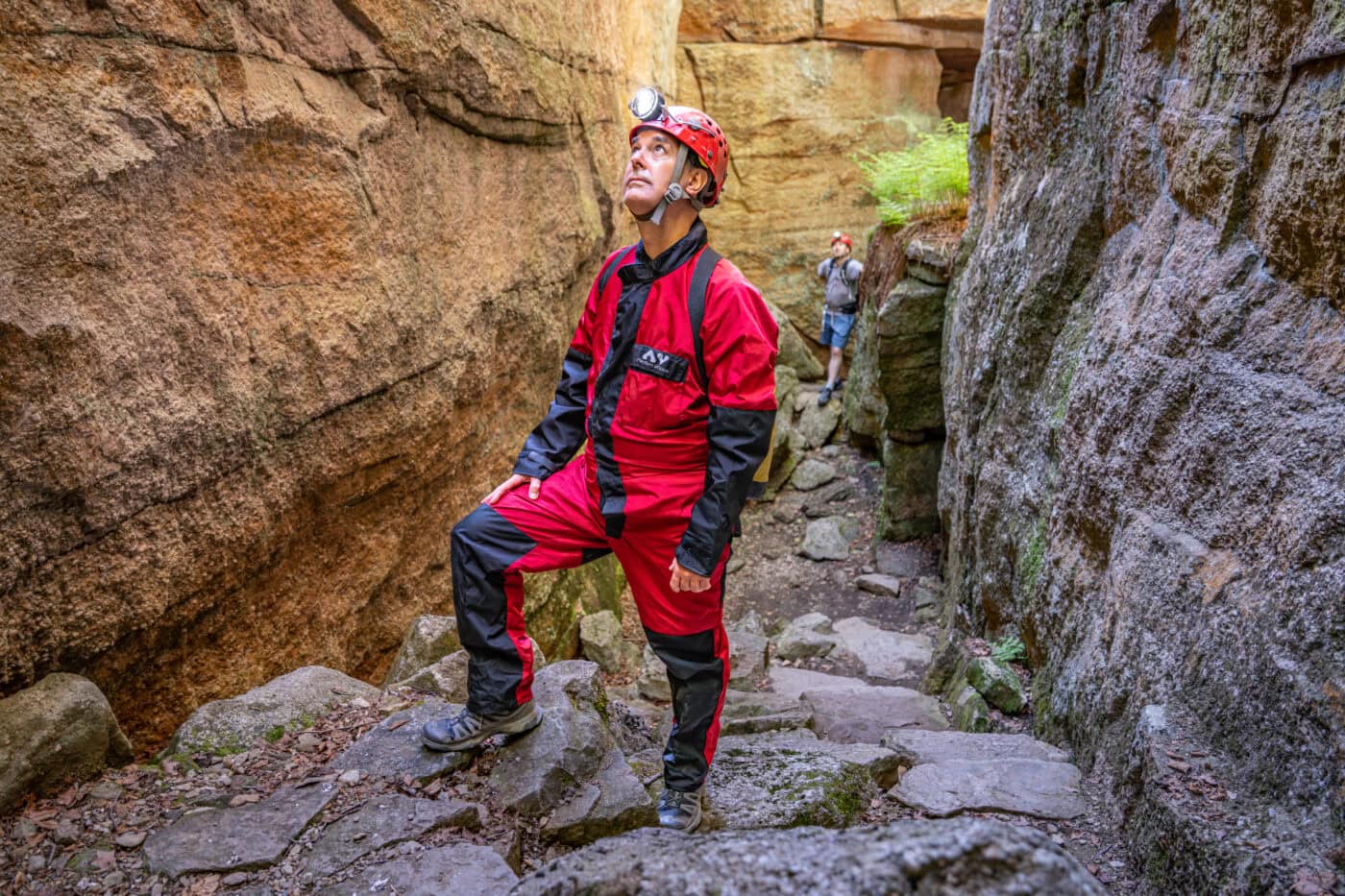
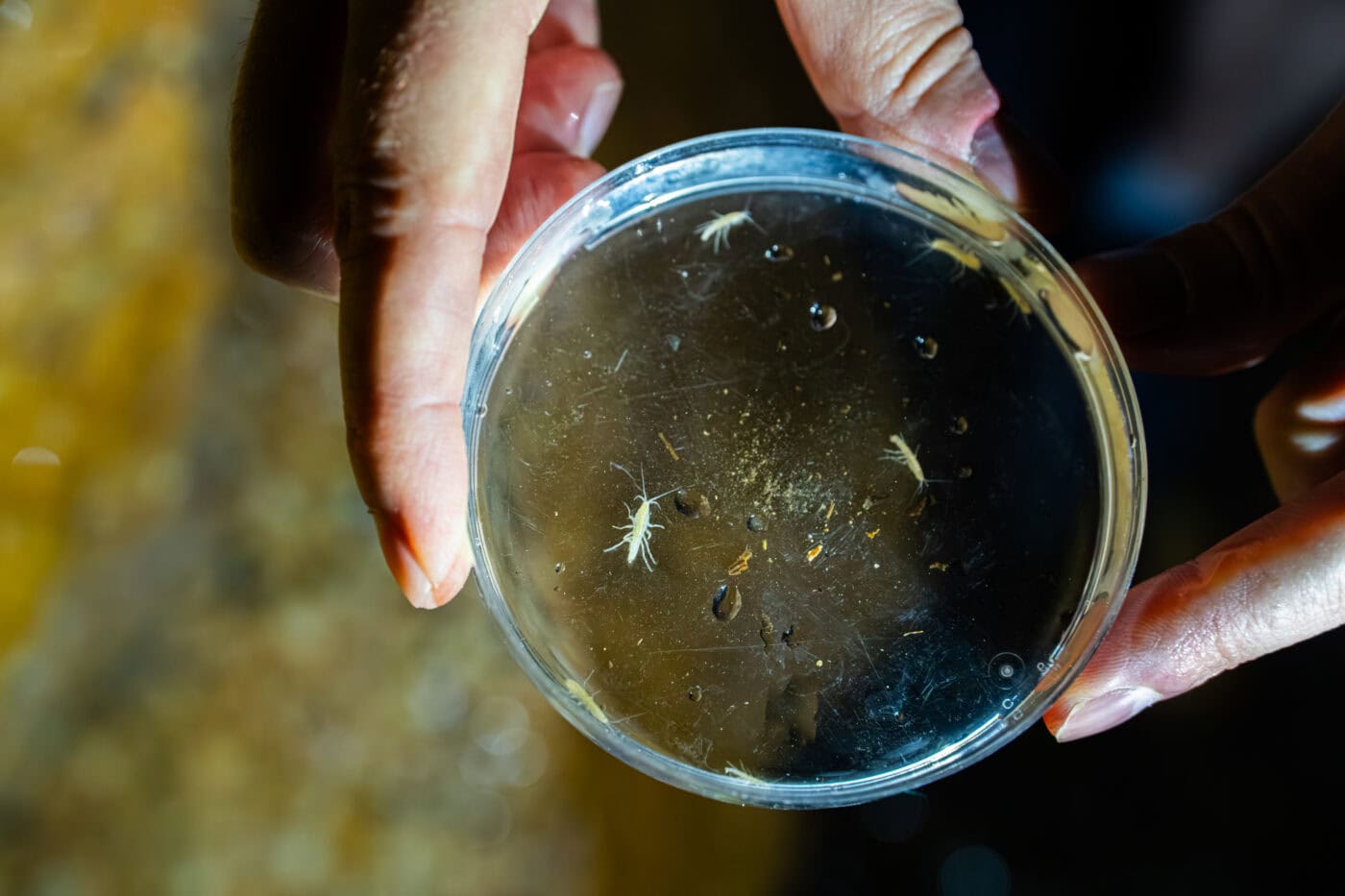
To learn more about this crustacean, I met up with Luis Espinasa, a biologist at Marist College, to hike the Sam’s Point Ice Caves trail in Minnewaska State Park. Espinasa has been visiting the ice caves for about 20 years. It didn’t take him long to find a small pool containing several amphipods, which he scooped out with a net into a petri dish for a closer look. They can be up to an inch long and look a bit like shrimp.
Like many life forms that are adapted to a very specific habitat, the Allegheny cave amphipods tell the history of their surroundings. Living in the darkness for thousands of years, they have lost the need for eyes or pigment. They swim in small pools or streams of water that flow between the crevices, but only where the conditions are persistently cool, wet, and dark.
These crustaceans can also be found elsewhere in the Shawangunk Ridge. And there are pockets of them scattered elsewhere in New York and throughout the Allegheny region of Pennsylvania and Maryland.
Espinasa says that melting glaciers that once moved through the region may have played a role in distributing these populations thousands of years ago. But there is also some genetic evidence that today’s populations aren’t entirely isolated from each other either, and he has an interesting theory about how that may happen. “If you dig under the gravel of a stream, there are many voids. For us it looks like a surface stream, but inside the gravel is a network of microcaves,” he says, noting a similarity to soil environments. “So they can travel from cave to cave through this underground system.”
One thing that is unique about this species of amphipods that live in Minnewaska’s ice caves is that they are the only population known to endure freezing. Espinasa thinks they do this by moving further down into crevices or beneath gravel where the water hasn’t frozen. But they can also survive for short periods being frozen in a solid chunk of ice, as he has shown in the lab.
His theory is that they used this adaptation to survive the last ice age. “I think that these organisms, they have a leftover adaptation,” he says. “But, for most of the time, generations go and they never use it — except in this particular population of the ice caves, it comes in handy every year.”
As we wrap up our hike, Espinasa told me about his plans to test this theory in part by collecting some of these amphipod crustaceans from a cave near Albany that doesn’t freeze. With assistance from some of his students, he’ll see if that population still has the ability to withstand freezing like the ones at Minnewaska do.
Regardless of what they find, Espinasa looks forward to learning more about how these blind and often unseen cave-dwelling crustaceans fit in to the geologic history of the Shawangunk Ridge. “They are really cool bugs,” he says, “very interesting.”