
The rate of sea level rise is accelerating around the world.
While the exact pace is not certain, there are many reasons to believe that sea level rise will continue to accelerate throughout this century. A lot depends on how much more greenhouse gas pollution humanity adds to the atmosphere. It also depends on how quickly the Greenland and Antarctic ice sheets melt and add their water to the oceans in response to global warming.
In 2022, the National Oceanic and Atmospheric Administration (NOAA) released revised scenarios of sea level rise, as well as estimates for sea level rise beyond the year 2100. The NOAA report points out that it is essential for planners to account for the worst-case scenario, as well as the most likely scenario, when considering risk in decisions.
Official New York State (NYS) projections for future sea level rise along the Hudson River and elsewhere in New York have been provided in reports from the NYS Task Force on Sea Level Rise and the NYS2100 Commission, and were updated in 2024. These projections include the range of sea level rise that is “likely”* to occur in a given time period, as well as “possible” but unlikely levels*, which must be considered for worst-case planning.
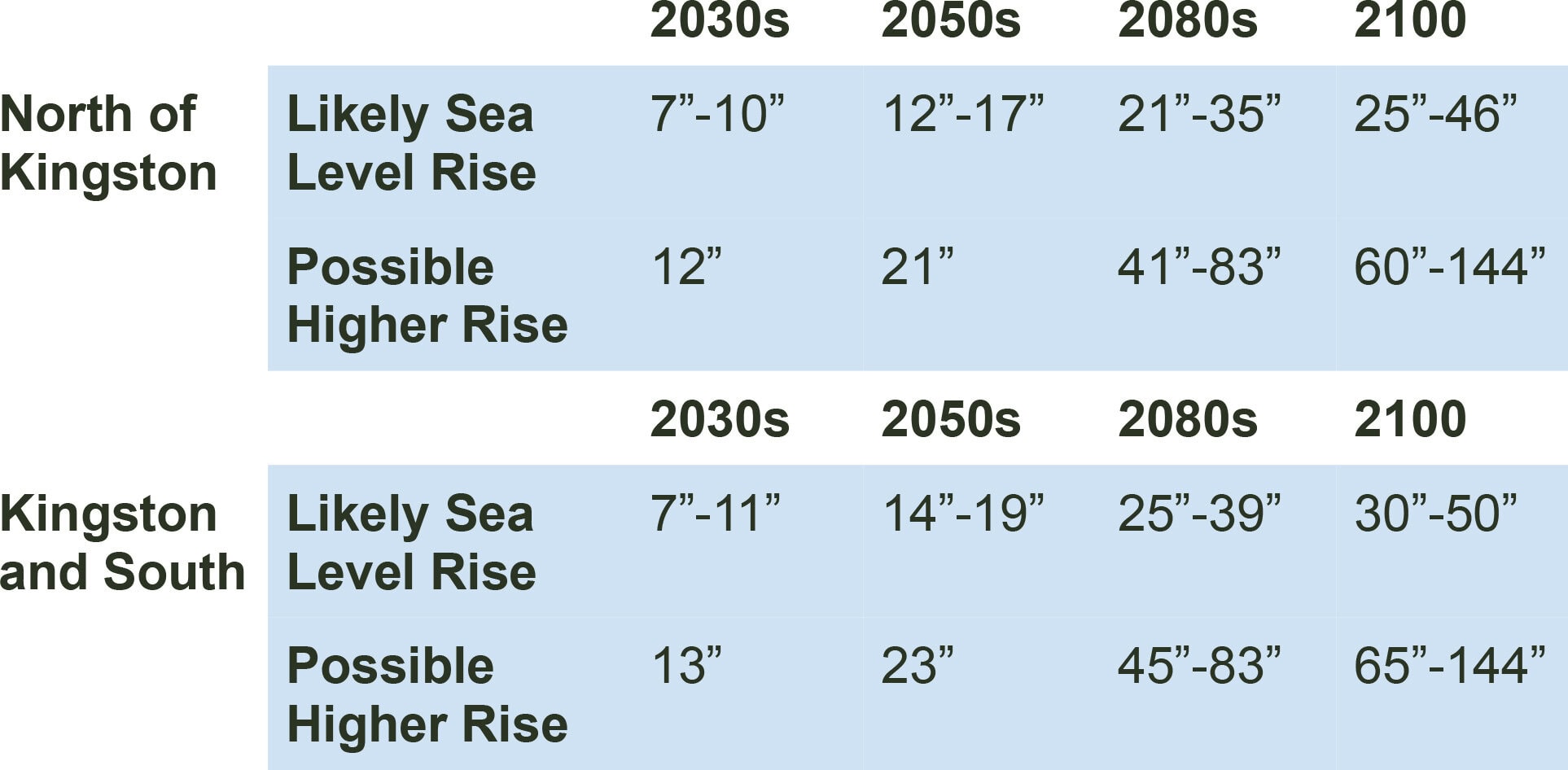
* The range of “likely” sea level rise is the amount of sea level rise that is between the 25th and 75th percentile of ClimAID model outputs, i.e., it is unlikely that sea level rise will be below the lower limit or above the upper limit of this range. “Possible” but unlikely sea level rise is above the 75th percentile of the ClimAID model outputs and includes the Rapid Ice Melt Scenario as the upper indicated level where it’s provided in the official projections.
The numbers above are interpreted from the Community Risk and Resiliency Act, available HERE. For more information, access the NYS Climate Impact Assessment HERE and the NYS Climate Change Projections Methodology HERE.